Samstag, 10. Mai 2014

Camera Lucida instructions

As we thoroughly considered the quality of the set of instructions, we found it lacks some vital points. First of all, a list of materials is missing. It is not very helpful if the items needed for the camera lucida have to be guessed from the text. The next critic regards the order of the instructions. Numbers for each step would have definitely been useful. The author seemed to have taken for granted a lot of things as he wrote the instructions. Not only did he choose to put the images without referring to what exact part of camera lucida was meant, nor did he establish a clear link between the paragraphs and the visual information. We agreed that if we were asked to build a camera lucida resorting only to this very set of instructions we would definitely end up with a bad result. We recommend to tackle these problems in order to render  it  a more structured, comprehensible and therefore useful instruction.

Montag, 5. Mai 2014

CAJ: Comparing three abstracts about topics relating to the journal


Human Extinction and Farsighted Universal Surveillance

Mark Walker (Department of Philosophy, New Mexico State University, La Cruces, NM, USA)

Volume 3, Issue 4. Copyright © 2012. 11 pages.

Abstract

This paper bridges the dilemma created by intrusive surveillance technologies needed to safeguard people’s security, and the potential negative consequences such technologies might have on individual privacy. The author begins with a brief review of the increasing threat to human life posed by emerging technologies, e.g., genetic engineering and nanotechnology. Next, they canvass a potential technological means to mitigate some of this threat, namely, ubiquitous microscopic sensors. The author then notes that a consequence of the deployment of such technology appears to be an erosion of personal privacy on a scale hitherto unimaginable. It is then argued that many details of an individual’s private life are actually irrelevant for security purposes, and that it may be possible to develop technology to mask these details in the data gleaned from surveillance devices. Such a development could meet some, perhaps many, of the concerns about privacy. It is also argued that if it is possible to use technology to mask personal information this may actually promote the goal of security, since it is conjectured that the public is likely to be more willing to accept such invasive technology if it is designed to mask such details. Finally, some applications to Society’s current uses of surveillance technology are drawn


Personal Comment:

This abstract discusses a core competence of the Lifeboat Foundation’s philosophy. Protecting people from intrusive use of technology is a rather current topic in times of growing surveillance and modernization. Even if the abstract is written as a quite monotonuous summary and somehow lacks findings it still manages to give the reader a concrete idea of the papers content.


Link: http://www.igi-global.com/article/human-extinction-farsighted-universal-surveillance/74714

Protection of the human race against natural hazards (asteroids, comets, volcanoes, earthquakes)

Joseph V. Smith1

 + Author Affiliations

1Department of the Geophysical Sciences, University of Chicago, Chicago, Illinois 60637

Abstract

Although we justifiably worry about the danger of nuclear war to civilization, and perhaps even to survival of the human race, we tend to consider natural hazards (e.g., comets, asteroids, volcanoes, earthquakes) as unavoidable acts of God. In any human lifetime, a truly catastrophic natural event is very unlikely, but ultimately one will occur. For the first time in human history we have sufficient technical skills to begin protection of Earth from some natural hazards. We could decide collectively throughout the world to reassign resources: in particular, reduction of nuclear and conventional weapons to a less dangerous level would allow concomitant increase of international programs for detection and prevention of natural hazards. Worldwide cooperation to mitigate natural hazards might help psychologically to lead us away from the divisive bickering that triggers wars. Future generations could hail us as pioneers of peace and safety rather than curse us as agents of death and destruction.


Personal comment:

The abstract resorts to very persuasive language in the beginning and therefore caught my attention right from the first sentence. It provokes a feeling of concern by referring to war in first place and then compare it to the power of natural phenomenons. Furthermore, the abstract tries to referr to the way the majority tends to think about the topic only to immediately smash it by saying that one day a truly catatstrophic natural event will occur. The abstract also ends on a high note and again a great level of persuasive language. I would not hesitate a second if I was asked to read the paper tot he abstract. It really fits perfectly into the topic of my CAJ.


COMET/ASTEROID PROTECTION SYSTEM (CAPS): A SPACE-BASED SYSTEM

CONCEPT FOR REVOLUTIONIZING EARTH PROTECTION AND UTILIZATION OF

NEAR-EARTH OBJECTS

Daniel

Renjith R. Kumar

Analytical Mechanics Associates, Inc.

Hampton, Virginia USA

ABSTRACT

There exists an infrequent, but significant hazard to life and property due to impacting asteroids and comets.There is currently no specific search for long-period comets, smaller near-Earth asteroids, or smaller shortperiod comets. These objects represent a threat with potentially little or no warning time using conventional ground-based telescopes. These planetary bodies also represent a significant resource for commercial exploitation, long-term sustained space exploration, and scientific research. The Comet/Asteroid Protection System (CAPS) would expand the current detection effort to include long-period comets, as well as small asteroids and short-period comets capable of regional destruction. A space-based detection system, despite being more costly and complex than Earth-based initiatives, is the most promising way of expanding the range of detectable objects, and surveying the entire celestial sky on a regular basis. CAPS is a future spacebased system concept that provides permanent, continuous asteroid and comet monitoring, and rapid, controlled modification of the orbital trajectories of selected bodies. CAPS would provide an orbit modification system capable of diverting kilometer class objects, and modifying the orbits of smaller asteroids for impact defense and resource utilization. This paper provides a summary of CAPS and discusses several key areas and technologies that are being investigated.

Personal comment:

The abstracts builds up the first argument claiming there has not yet been a lot of research and measures to protect the Earth from asteroids. The idea to start with a scenario where there is no protection provided for a catastrophy that could potentially eradicate the earth’s population is quite shocking.


Link: http://www.cs.odu.edu/~mln/ltrs-pdfs/NASA-2002-53iac-ddm.pdf

Mittwoch, 30. April 2014

CAJ:Curious aspects regarding the 'Svalbard Global Seed Vault'

The 'Svalbard Global Seed Vault' is an ambitious project to store seeds from all over the world. It is situated in the Norwegian city of Svalbard, one of the most remote towns in the world. As far as financing goes, it is primarily supplied by the ‘Bill and Melinda Gates Foundation’. Other sponsors include the US agribusiness giant Du Pont/Pioneer hi-Bred and the Rockefeller Foundation.

Regarding the dimensions of the bank, it will store 3 millions of different crops of the global flora. The walls used for the bank will be one-metre thick and supported by massive steel. The main aim of the project is to preserve the global seed diversity for the future and save it from all calamities the world could  possibly be confronted with one day. This is why Svalbard is also referred to as the ‘doomsday seed bank’.
A closer look at what seems so entirely inspired by nobel motifs, however, will reveal some curious facts about the bank. The real beneficiaries of such seeds banks are namely scientists and large plant breeders as Monsanto and DuPont. The Monsanto shares the world patent rights for Genetic Use Restriction Technology with the US Government. This technology works with special seeds that commit suicide once they are harvested. As a consequence, farmers are forced to buy new seeds each year and therefore steadily earn Monsanto a fortune. The control of private seed companies is likely to grow even more due to such seed banks.


Another interesting fact involves the aforementioned Rockefeller Foundation. Ever since the early twentieth century, it has been interested in eugenics. Actually the Rockelfeller Foundation was a great supporter of the Ayran Master Race of the Nazis and their striving for the perfection of the human race. Hitler’s researchers have taken genetic engineering a long way. A company, which now seems to have rediscovered its fascination for genetic perfection in the Svalbard Global seed Vault somehow does not lack a certain macabre note.

After all and despite critical notes, the Svalbard Global Seed Vault should in first place still be seen as the result of a high reputation of the nature and the flora surrounding us. 

Freitag, 4. April 2014

Diary of the bloody civil war in Syria

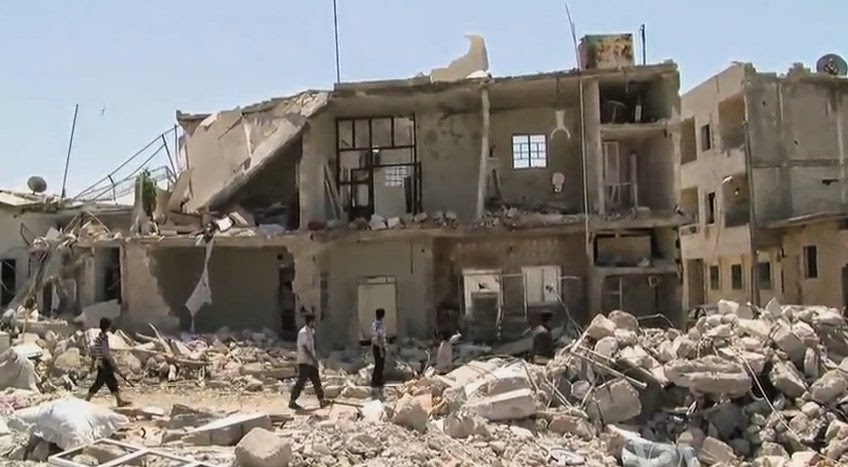
Silence fills Aleppo, a Syrian city, perched on a tiny mountain near the desert. The strong afternoon sun heats up the stone and the residuals of the abandoned ruins that used to be houses of happy families. Every now and then, the silence is interrupted by sequences of gunfire audible in the distance. Within a few days, the once so peaceful city has turned into a place of violence and hopelessness. The atrocities of the syrian civil war have invaded the city and caused thousands of victims. Many people were forced to leave their homes behind. In the middle of all this, a boy limps over traces of broken glass and scrap metal. He wears no shoes. Shorts and a ripped shirt barely hide the scarves and blood all over his body. His soft small face is covered with dust and his big black eyes are filled with tears. The kid is nine-year old Ashid. He, just as many other children has become an orphan ever since his parents were killed in a bomb attack on their house.

Donnerstag, 3. April 2014

Description of the boy with the toy hand grenade

The black-and-white photograph of the boy with the toy hand grenade was probably taken in a park during daytime. A few people can be discerned in the background. The shadow of a tree falls on the small and delicate figure of a young boy, wearing a patterned shirt and dark shorts. He has suspenders of which one side has slipped down his left shoulder. In his right hand he firmly holds a toy hand grenade. His fragile legs seem to disappear to the thick socks in his shoes. He slightly leans his head to his left side and despite the colorless picture one might guess his blond hair. The expression on his face seems awkwardly tense. His lips are pinched and he is starring with wide-open eyes. The rest of his body, especially his left hand looks cramped and nervous as well. The boy’s knees are covered with dirt. He appears desperate and lonely standing on the asphalt amid the park.

Freitag, 21. März 2014

'After-Death-Avatars'

There is hardly anything more devastating and dreadful than the decease of a loved person. Thanks to ‘After-Life-Avatar’, however, overcoming such traumatic situations can be made less deplorable. So it’s up to you! Either you suffer for the rest of your life or you go and get you an ‘After-Life Avatar’.


Dienstag, 18. März 2014

CAJ:‘The lifeboat foundation’ and other programs with the ultimate intentions to safeguard humanity, the earth’s biodiversity, and moreover enable their expansion into the solar system


 "If humans one day become extinct from a catastrophic collision, there would be no greater tragedy in the history of life in the universe. Not because we lacked the brain power to protect ourselves but because we lacked the foresight.“

 Organizations such as ‘The lifeboat foundation‘ tackle the ambiguity of modern technology as both, cause of and solution to threat of the human population on earth at the same time. We are part of an era of ever advancing technology encompassing more sections of our lives each day. While things are made more efficient, faster or possible at all, we tend to forget about the disadvantages, risks and dangers scientific progress brings about as well. We should be curious about what is currently being done to protect human beings from the negative effects Artificial Intelligence could potentially cause. So speaking of threat in this context, misuse and other malign impacts of high technology on humans must be avoided by all means, and this is exactly what ‘the lifeboat foundation’ actually aims for.

 Apart from this, however, its ambitious programs also use technology in order to provide protection for humanity from all kinds of danger. Not only tries it to preserve life and biodiversity on Earth by developing bio shields, asteroid protection systems or weather warning devices, but also tries to put forward the realization of plans regarding the population of the solar system. Actually, transferring most of the earth’s biodiversity to Mars is one of the major goals of the foundation.

I hope I could highlight what the content of my CAJ will be like. I am really looking forward to the CAJ as I am sure I will be having a tremendously exciting and interesting time doing the research work for it.